






The emergence of evil
| Brand | Jānis Roze |
| Condition | Used, in good condition |
| Language | Latvian |
| Added | Yesterday, 19:144 |
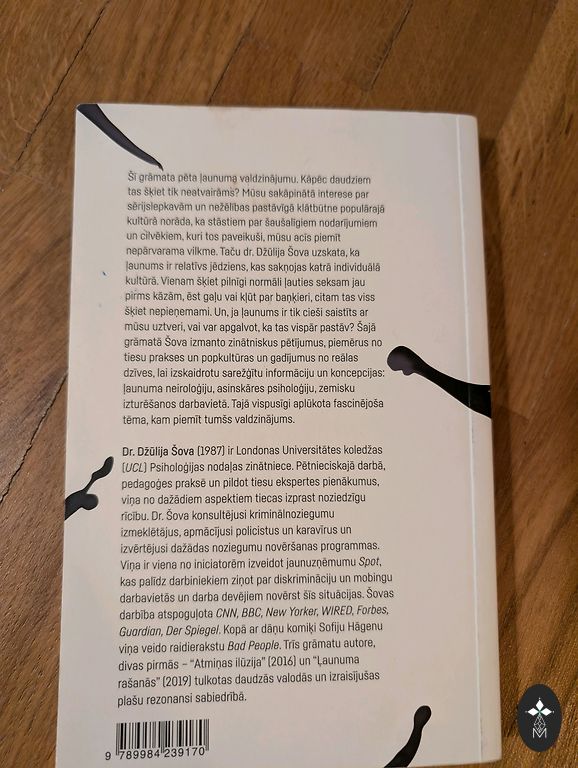
This book explores the allure of evil. Why does it seem so irresistible to many? Our heightened interest in serial killers and the constant presence of cruelty in popular culture suggest that stories of horrific deeds and the people who commit them hold an irresistible attraction in our eyes. However, Dr. Julia Shaw believes that evil is a relative concept rooted in each individual culture. For some, it seems perfectly normal to indulge in sex before marriage, eat meat, or become a banker, while for others, all of this seems unacceptable. And if evil is so closely tied to our perception, can it be claimed to exist at all? In this book, Shaw uses scientific research, examples from legal practice and pop culture, and real-life cases to explain complex information and concepts: the neurology of evil, the psychology of bloodthirstiness, and malicious behavior in the workplace. It thoroughly examines a fascinating topic with a dark allure. Dr. Julia Shaw (1987) is a scientist at the Psychology Department of University College London (UCL). In her research, teaching practice, and fulfilling her duties as a forensic expert, she seeks to understand criminal behavior from various aspects. Dr. Shaw has advised criminal investigators, trained police officers and soldiers, and evaluated various crime prevention programs. She is one of the initiators of the startup Spot, which helps employees report discrimination and bullying in the workplace and assists employers in addressing these situations. Shaw's work has been featured on CNN, BBC, New Yorker, WIRED, Forbes, Guardian, Der Spiegel. Together with Danish comedian Sofie Hagen, she produces the podcast Bad People. Author of three books, the first two – "The Memory Illusion" (2016) and "Making Evil" (2019) – have been translated into many languages and sparked widespread public resonance. Translated from English by Ilmārs Zvirgzds.